How to Understand Your Namaz: A Beginner’s Guide to Salah Meanings
· Updated · 6 min read · by QuranEasy team
In short
- Start with the words you say most often: Surah al-Fatiha, the takbīr and the tasbīḥ of rukūʿ and sujūd.
- Learn three grammar ideas first: the three kinds of words, the case endings and possessive phrases.
- Take one phrase a day, and bring its meaning to mind in your next prayer.
- In about a month, most of what you say in a two-rakʿah prayer can have a meaning attached to it.
Most Muslims pray five times a day, and many of us do not know the meaning of what we recite. That is not a failure of faith. It is simply a gap: we learned to read and memorise the Arabic as children, but no one taught us how the language works. The good news is that the gap is smaller than it looks. Namaz uses a short list of phrases, repeated many times a day, so every phrase you learn pays off again and again.
This guide gives you a practical path: where to begin, which grammar matters most, a simple 30-day plan and the mistakes that slow people down.
Why understanding your Namaz is worth the effort
The Qur’an tells believers not to approach prayer in a state where they “do not know what they are saying” (An-Nisā’ 4:43). The verse is about a specific situation, but it shows something important: prayer is meant to be said with awareness. The Qur’an also praises those who are humble in their prayer (Al-Mu’minūn 23:1–2). Knowing what you say is one of the most practical ways to build that humility and presence, called khushūʿ.
There is also a simple practical reason. When words are only sounds, the mind has nothing to hold on to, and it drifts to work, family and the phone. When each phrase carries a meaning, the mind has something to do. We look at this in detail in Khushu in prayer.
Step 1: Start with what you say most
Do not begin with a grammar book from page one. Begin with the words you will say again in a few hours:
- Allāhu akbar (اللَّهُ أَكْبَرُ): “Allah is the Greatest”, said at every change of position.
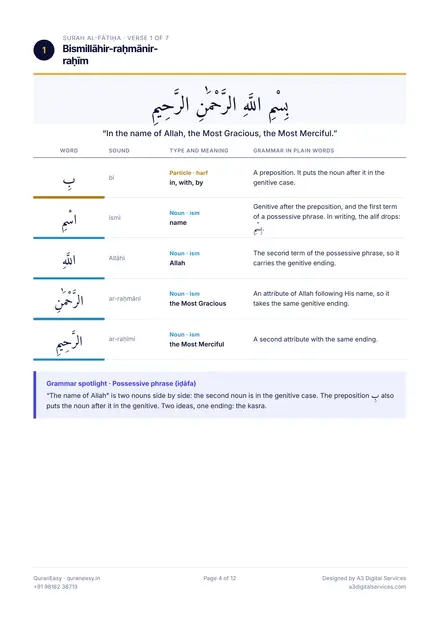
- Surah al-Fatiha: recited in every rakʿah, seven verses and fewer than thirty words.
- Subḥāna rabbiya-l-ʿaẓīm: “Glory be to my Lord, the Most Great”, in rukūʿ.
- Subḥāna rabbiya-l-aʿlā: “Glory be to my Lord, the Most High”, in sujūd.
- As-salāmu ʿalaykum wa raḥmatullāh: “Peace be upon you, and the mercy of Allah”, to end the prayer.
Just these give meaning to a large part of every prayer. All of them, with notes, are on our page Namaz meaning word by word, and Surah al-Fatiha has its own free word-by-word PDF guide.
Step 2: Learn three grammar ideas that unlock the rest
You do not need hundreds of rules. Three ideas explain most of what you say in Namaz.
1. Every word is a noun, a verb or a particle
Arabic words fall into three groups: ism (noun), fe’il (verb) and harf (particle). In إِيَّاكَ نَعْبُدُ (iyyāka naʿbudu), إِيَّاكَ is a pronoun (a kind of ism) meaning “You alone”, and نَعْبُدُ is a verb meaning “we worship”. Once you can label the words, a phrase stops being a wall of sound.
2. Endings show each word’s role
A ḍamma (-u) usually marks the subject: الْحَمْدُ (al-ḥamdu, “the praise”). A kasra (-i) usually marks a noun after a preposition or the second noun of a possessive phrase: بِسْمِ اللَّهِ (bismi-llāhi). A fatḥa (-a) often marks the object of a verb. These are first rules, not the whole story, but they give you a map.
3. Two nouns side by side mean “X of Y”
رَبِّ الْعَالَمِينَ is “Lord of the worlds”. اسْمِ اللَّهِ is “the name of Allah”. This possessive construction, called iḍāfa, appears everywhere in prayer. The grammar basics page explains all three ideas with more examples, and the glossary defines every term.
Step 3: A simple 30-day plan
- Days 1–7: the takbīr, the Basmala and the first three verses of al-Fatiha. One phrase a day.
- Days 8–14: the rest of al-Fatiha. Notice the shift from speaking about Allah (“the Master of the Day of Judgment”) to speaking to Him (“You alone we worship”).
- Days 15–21: the tasbīḥ of rukūʿ and sujūd, and the words said when rising from rukūʿ.
- Days 22–30: the opening of the tashahhud and the taslīm, then review everything once.
Each day, read the phrase, say its meaning aloud, and pick one prayer in which you will consciously remember it. That is enough. Consistency matters far more than long sessions.
Step 4: Connect meaning to the moment you say it
Learning a meaning at your desk is the first half. The second half is recalling it while you pray. A simple method: in each prayer, choose one phrase to “be present for”. When you reach it, slow down slightly and think of its meaning. Over weeks, the number of phrases you are present for grows naturally.
Common mistakes to avoid
- Trying to learn everything at once. A long list of meanings is forgotten quickly. A short list, used daily, stays.
- Relying only on a translation. Translations help, but if you never look at the Arabic words, the meaning stays outside the prayer. Learn which Arabic word carries which meaning. See reciting vs understanding the Qur’an.
- Learning spoken Arabic instead. Conversational courses teach greetings and shopping. Your Namaz needs Quranic vocabulary and grammar. Read Quranic Arabic vs Modern Standard Arabic.
- Studying alone without feedback. A teacher corrects small misunderstandings before they become habits.
When to get a teacher
Self-study can take you through the phrases of Namaz. To move from phrases to the verses of the Qur’an, most adults benefit from a structured course and a teacher they can ask. QuranEasy teaches one course for this purpose: the 6-month Quranic Arabic Course, live on Zoom with Sir Abdurrahim, in Hindi, Urdu or English, for learners aged 15 and above who can read the Qur’an.
Frequently asked questions
Can I understand my Namaz without learning Arabic grammar?
You can memorise meanings, and that is a good start. Grammar is what lets you see why each word means what it does, which makes the meaning stick and lets you understand new verses on your own.
How long does it take to understand the words of Namaz?
With one phrase a day, most learners can attach a meaning to the core phrases of a two-rakʿah prayer in about a month. Understanding the verses of the Qur’an more broadly takes longer; our course is designed around six months.
Is the wording of Namaz the same for everyone?
The core is shared by all Muslims. Some supplications differ slightly between schools of thought. The phrases in our guide are those widely used in South Asia.
Where should I start today?
Download the free Surah al-Fatiha word-by-word guide and learn the first verse today. If you would like a teacher, book a free trial class.