
Khushu in Prayer: How Understanding the Words Helps Concentration
· Updated · 5 min read · by QuranEasy team
In short
- Khushūʿ is humility and presence of heart in prayer; the Qur’an praises those who have it.
- The mind wanders when words are only sounds. Meaning gives it something to hold.
- Practical steps: prepare before prayer, slow down, focus on one phrase per prayer, and learn what each phrase means.
- Understanding the Arabic is one of the most lasting ways to build khushūʿ.
Almost everyone has had this experience: you finish a prayer and realise you were thinking about work, a conversation or tomorrow’s plans the whole time. It is one of the most common struggles Muslims mention. This article explains what khushūʿ is, why concentration slips, and the practical steps that help, with special attention to the one most people overlook: understanding the words.
What is khushūʿ?
Khushūʿ (خُشُوع) is humility, stillness and presence of heart in prayer. The Qur’an opens Sūrat al-Mu’minūn with it: “Successful indeed are the believers, those who are humble in their prayers” (Al-Mu’minūn 23:1–2). It also describes prayer as heavy except for those who have this humility (Al-Baqarah 2:45).
Khushūʿ has an inner side (the heart is attentive and humble) and an outer side (the body is calm and unhurried). Both support each other.
Why the mind wanders in Salah
- Habit. We have prayed the same words thousands of times. The tongue can now run without the mind.
- Rushing. When prayer is squeezed between tasks, the mind is still in the last task or already in the next one.
- Words without meaning. If the words are only sounds, there is nothing for the mind to engage with, so it finds something else.
The first two are about preparation and pace. The third is about knowledge, and it is the one we can fix permanently.
How meaning gives each phrase a job
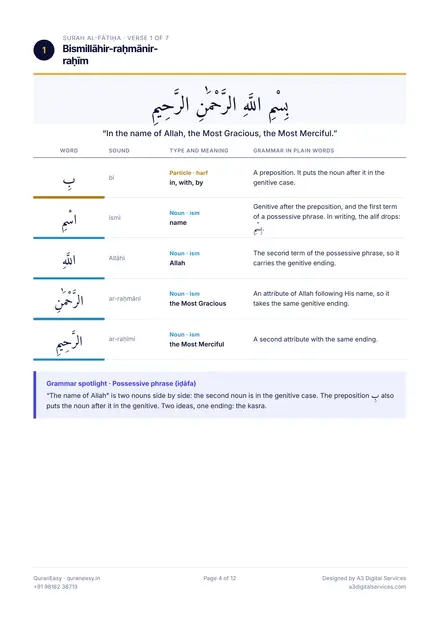
Consider Surah al-Fatiha, which you recite in every rakʿah. When you know what each verse means, the prayer becomes a conversation with a clear shape:
- الْحَمْدُ لِلَّهِ رَبِّ الْعَالَمِينَ: “All praise is for Allah, Lord of the worlds.” You begin with praise.
- مَالِكِ يَوْمِ الدِّينِ: “Master of the Day of Judgment.” You remember accountability.
- إِيَّاكَ نَعْبُدُ وَإِيَّاكَ نَسْتَعِينُ: “You alone we worship, and You alone we ask for help.” The speech turns from about Allah to to Him, and “You” comes first for emphasis.
- اهْدِنَا الصِّرَاطَ الْمُسْتَقِيمَ: “Guide us to the straight path.” Now you ask.
Each verse gives the mind a task: praise, remember, commit, ask. That is very different from reciting sounds. The whole surah is explained word by word in our free Surah al-Fatiha guide.
The same is true in rukūʿ and sujūd. Subḥāna rabbiya-l-ʿaẓīm (“Glory be to my Lord, the Most Great”) is said while bowing; subḥāna rabbiya-l-aʿlā (“Glory be to my Lord, the Most High”) while your forehead is on the ground, at your lowest. Knowing the meaning makes the posture and the words say the same thing. See all the phrases in Namaz meaning word by word.
Practical steps to build khushūʿ
Before the prayer
- Make wuḍūʾ calmly. Treat it as the start of the prayer, not a chore before it.
- Clear the space. Put the phone face down or in another room.
- Pause for a breath. A few seconds of stillness before the takbīr helps the mind arrive.
During the prayer
- Slow down slightly. Not dramatically; just enough that each phrase is said, not rushed.
- Choose one phrase to be present for. In this prayer, focus on one phrase and its meaning. Next prayer, another.
- Let the posture match the words. Bowing and prostration are physical humility; the words describe the same.
- When you notice the mind has wandered, return gently. Noticing is itself a success.
Over the weeks
- Learn one new phrase each day until every part of your prayer has a meaning attached.
- Learn the grammar behind them. When you understand why a word means what it does, the meaning arrives faster during prayer (grammar basics).
A one-week experiment
- Day 1: learn the meaning of the takbīr and the first verse of al-Fatiha.
- Day 2: verses 2–4. Notice the shift from praise to judgment.
- Day 3: verse 5, “You alone we worship”.
- Day 4: verses 6–7, the request for guidance.
- Day 5: the tasbīḥ of rukūʿ and sujūd.
- Day 6: the words when rising from rukūʿ and the taslīm.
- Day 7: pray once slowly, recalling every meaning you learned.
Most people notice a difference within the week. Not perfection, but more moments of presence.
Why understanding lasts
Tips such as slowing down and clearing distractions work, but they depend on effort each time. Understanding works on its own: once a phrase has a meaning for you, it carries that meaning every time you say it, for the rest of your life. That is why we teach Quranic Arabic through the words of Namaz first.
QuranEasy teaches one course: the 6-month Quranic Arabic Course, live on Zoom with Sir Abdurrahim, in Hindi, Urdu or English, for learners aged 15 and above who can read the Qur’an. It begins with the grammar of your prayer and moves on to reading the verses.
Frequently asked questions
Is my prayer valid if I lose concentration?
Concentration affects the quality and reward of the prayer; questions about validity should be taken to a scholar you trust. Everyone’s mind wanders at times; the aim is to keep returning.
Can I build khushūʿ without learning Arabic?
Preparation, pace and focus all help. Understanding the words adds a lasting support that does not depend on effort each time.
How quickly can I learn the meanings of my prayer?
With one phrase a day, the core phrases can have meanings attached within a few weeks. See how to understand your Namaz.
Start with the free Surah al-Fatiha guide, or book a free trial class.
1 comments