
Quranic Arabic Grammar Basics: A Beginner’s Guide
Live on Zoom with Sir Abdurrahim · Free trial class · Flexible schedules
- Format
- Live on Zoom
- Who
- Ages 15+, can read the Qur’an
- Languages
- Hindi · Urdu · English
- Tutor
- Sir Abdurrahim
- Start
- Free trial class
In short
- Every Arabic word is a noun (ism), a verb (fe’il) or a particle (harf).
- Word endings (-u, -a, -i) show each word’s role in the sentence.
- Most words grow from three-letter roots, so one root unlocks many words.
- A few rules explain most of what you recite in Namaz.
The Qur’an describes itself as “an Arabic Qur’an so that you may understand”. You do not need to speak Arabic to start understanding it. You need a small set of grammar ideas, practised on words you already know. Here are the foundations, with examples from your prayer.
1. Three kinds of words
- Ism (noun): names a person, thing, place or idea: رَبّ (Lord), الْحَمْد (the praise). Pronouns and adjectives are also ism.
- Fe’il (verb): an action tied to time: نَعْبُدُ (we worship), اهْدِنَا (guide us).
- Harf (particle): links words and shapes meaning: بِ (in, with), لِ (for), مِنْ (from).
2. “The”: al- and tanwīn
الْ means “the”: الْكِتَابُ is “the Book”. An indefinite noun usually takes tanwīn, an extra “n” sound: هُدًى is “a guidance”.
3. The three case endings
- -u (rafʿ): the subject: الْحَمْدُ لِلَّهِ, “the praise is for Allah”.
- -a (naṣb): the object: إِيَّاكَ نَعْبُدُ, “You we worship”.
- -i (jarr): after a preposition or as the second noun of a possessive: بِسْمِ اللَّهِ.
This system is called iʿrāb. It is why word order in Arabic can move for emphasis without the meaning getting lost.
4. The possessive phrase (iḍāfa)
Two nouns side by side mean “X of Y”: رَبِّ الْعَالَمِينَ, “Lord of the worlds”; اسْمِ اللَّهِ, “the name of Allah”. The second noun always ends in -i.
5. Sentences without “is”
Arabic does not need a word for “is”. اللَّهُ أَكْبَرُ is already a full sentence: “Allah is the Greatest”. The first noun is the subject (mubtada’), the second the predicate (khabar).
6. Attached pronouns
Small endings carry “my, your, our, him”: رَبِّي (my Lord), رَبُّنَا (our Lord), حَمِدَهُ (he praised Him). Spotting them unlocks a large part of every prayer.
7. Roots and patterns
Most words come from a three-letter root. The root ح م د (praise) gives حَمْد (praise), حَمِدَ (he praised), مَحْمُود (praised) and the name مُحَمَّد. Patterns such as أَفْعَل build related meanings: أَكْبَر (greater), أَعْلَىٰ (higher).
Practise on your Namaz
Try these ideas on Namaz meaning word by word and the free Surah al-Fatiha guide. Every term is in the glossary, and the full path is in the course syllabus.
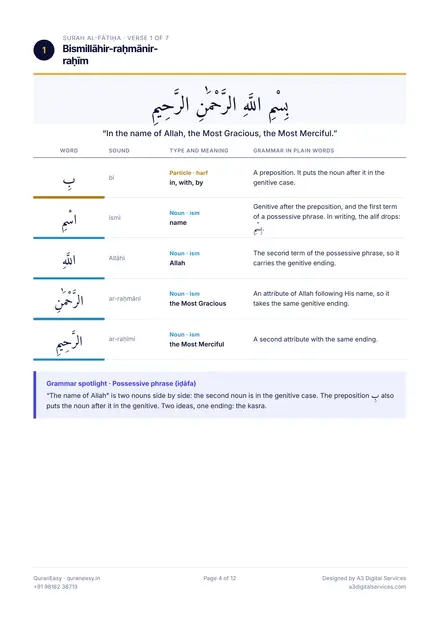
Free PDF download · 12 pages
Understand Surah al-Fatiha, word by word
The chapter you recite in every rak‘ah, taken apart. All seven verses, every word translated, colour-coded as noun, verb or particle, with the grammar explained in plain English. Each verse gets its own page.
- The complete Surah al-Fatiha, all 7 verses
- Word-by-word meaning, sound and grammar role
- A grammar spotlight for every verse
- A word bank of all 27 words to test yourself
Get the free guide
رَبِّ زِدْنِي عِلْمًا
Start with a free trial class
Tell us your level and the time that suits you. We will reply on WhatsApp or phone.