Reciting vs Understanding the Qur’an: Why Both Matter
· Updated · 5 min read · by QuranEasy team
In short
- Reciting the Qur’an is worship and is rewarded, even when you do not understand every word.
- The Qur’an also repeatedly invites reflection (tadabbur), which needs understanding.
- Translations help, but learning the Arabic lets the meaning reach you during recitation and prayer.
- You do not have to choose: keep reciting, and add understanding one phrase at a time.
Many Muslims grew up reciting the Qur’an beautifully without understanding it, and some feel uneasy about that. Others worry that focusing on understanding might take something away from recitation. Both concerns deserve a clear answer: recitation and understanding are not rivals. Each has its own value, and together they are what the Qur’an asks of us.
The value of recitation
Recitation is an act of worship in itself. The Prophet ﷺ said that whoever recites a letter of the Book of Allah receives a good deed, and each good deed is multiplied ten times (Jāmiʿ at-Tirmidhī 2910). He also said, “The best of you are those who learn the Qur’an and teach it” (Ṣaḥīḥ al-Bukhārī 5027). Recitation keeps the Qur’an on our tongues and in our homes, and it is the doorway to everything else. Nothing in this article takes away from it.
The Qur’an’s invitation to understand
At the same time, the Qur’an speaks of itself as a book to be understood and reflected upon:
- “Indeed, We have sent it down as an Arabic Qur’an so that you may understand” (Yūsuf 12:2).
- “A blessed Book which We have sent down to you, that they may reflect upon its verses” (Ṣād 38:29).
- “Do they not reflect upon the Qur’an?” (Muḥammad 47:24).
- “We have certainly made the Qur’an easy for remembrance” (Al-Qamar 54:17).
Reflection (tadabbur) means thinking about what a verse says and what it asks of you. That requires knowing what it says. Understanding is the bridge between hearing the words and acting on them.
Why translation alone is not enough
Translations are a blessing; read them. But they have limits:
- A translation is one interpretation. Translators must choose one English or Urdu word where the Arabic may carry several layers.
- Word order and emphasis are lost. إِيَّاكَ نَعْبُدُ puts “You” first: “You alone we worship.” A plain translation may say “We worship You” and lose the emphasis.
- The meaning stays outside the prayer. In Salah you recite Arabic, not the translation. Unless you know which Arabic word means what, the translation you read earlier does not come to mind while you pray.
A little grammar changes this. When you know that رَبِّ means “Lord” and that the -i ending ties it to the word before, رَبِّ الْعَالَمِينَ becomes “Lord of the worlds” in your own mind, in real time. See how the phrases of prayer work on Namaz meaning word by word.
What understanding changes
In prayer
When the words carry meaning, the mind has something to hold. Many learners describe more presence and humility, what the Qur’an calls khushūʿ (Al-Mu’minūn 23:1–2). More on this in Khushu in prayer.
In recitation
Verses you have recited for years suddenly have a voice. A promise, a warning, a story or a prayer is recognised as it arrives.
In daily life
Understanding lets the Qur’an guide decisions, because you know what it says instead of only how it sounds.
How to add understanding without losing recitation
- Keep your recitation routine. Do not replace it; add to it.
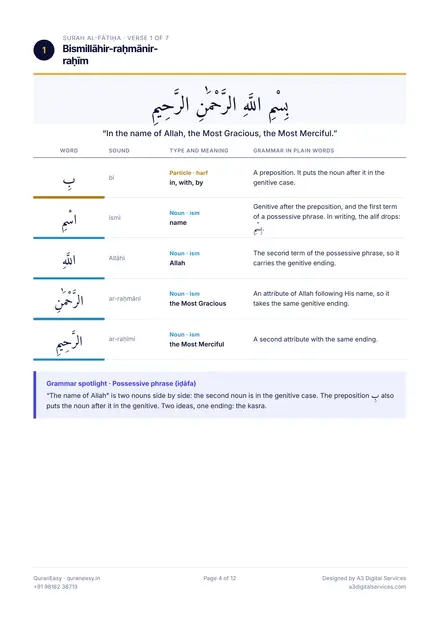
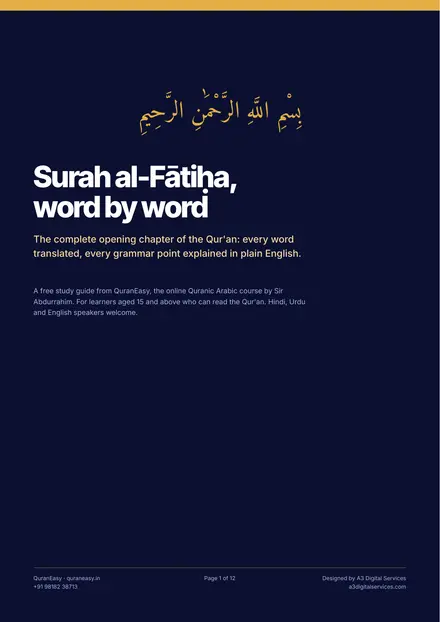
- Pick a small portion to understand deeply. Start with Surah al-Fatiha, which you recite in every rakʿah (free word-by-word guide).
- Learn the grammar that repeats. A few ideas, such as word types, endings and possessive phrases, unlock a large part of the Qur’an (grammar basics).
- Read the translation after you have tried the Arabic. It becomes a check rather than a replacement.
- Study with a teacher. A structured course gives you a path and answers your questions.
A note for those who learned to read as children
If you can read the Qur’an, you have already done the hardest part: you know the script, the sounds and the rhythm. Understanding builds directly on that. This is why our only requirement for the 6-month Quranic Arabic Course is that you can read the Qur’an and are aged 15 or above. Classes are live on Zoom with Sir Abdurrahim, in Hindi, Urdu or English.
Frequently asked questions
Am I rewarded for reciting if I do not understand?
Recitation is an act of worship and is rewarded. Understanding is an additional good that brings reflection and presence; it does not cancel the reward of recitation.
Should I stop reciting until I understand?
No. Keep reciting. Add understanding gradually alongside it.
Is reading a translation the same as understanding?
It gives you the meaning in general terms. Understanding the Arabic lets that meaning reach you while you recite and pray, and shows details a translation may not carry.
Begin with the free Surah al-Fatiha guide, or book a free trial class.