
Quranic Arabic vs Modern Standard Arabic: What Is the Difference?
· Updated · 5 min read · by QuranEasy team
In short
- Quranic Arabic is the Classical Arabic of the Qur’an. Modern Standard Arabic (MSA) is the formal Arabic of today’s news, books and speeches.
- They share the same core grammar: nouns, verbs, particles, case endings and the root system.
- They differ in vocabulary, word meanings, style and what courses focus on.
- If your goal is to understand the Qur’an and your prayers, study Quranic Arabic grammar and vocabulary directly.
Adults who want to understand the Qur’an often ask the same question: should I take a general Arabic course, or a Quranic Arabic course? The two are closely related, so the answer is not obvious. This article explains what each one is, what they share, where they differ and which path suits which goal.
What is Quranic Arabic?
Quranic Arabic is the language of the Qur’an, a form of Classical Arabic. The Qur’an describes itself as “an Arabic Qur’an so that you may understand” (Yūsuf 12:2). Its grammar became the basis of the Arabic grammar tradition: early grammarians studied the language of the Qur’an and classical poetry to describe how Arabic works.
When people say “Quranic Arabic” as a course, they usually mean Arabic taught for the purpose of understanding the Qur’an: the grammar and the vocabulary that actually appear in it, practised on real verses.
What is Modern Standard Arabic?
Modern Standard Arabic (MSA, al-fuṣḥā in its modern form) is the standard written and formal language used across the Arab world today: newspapers, books, television news, official documents and speeches. Everyday conversation in each country uses a local dialect, which differs from MSA much more than MSA differs from Classical Arabic.
What the two share
- The same building blocks. Nouns (ism), verbs (fe’il) and particles (harf). See grammar basics.
- The same case system. Endings in -u, -a and -i show a word’s role, a system called iʿrāb (glossary).
- The same root system. Words grow from three-letter roots: ك ت ب gives كِتَاب (book), كَتَبَ (he wrote), مَكْتُوب (written).
- The same script. Though the Qur’an’s written form (rasm) and vowel marks have their own conventions.
Because the foundation is shared, learning one makes the other easier. That is good news: whichever you start with, nothing is wasted.
Where they differ
1. Vocabulary
MSA contains thousands of modern words that never appear in the Qur’an: technology, politics, science and daily life. A general course spends a great deal of time on them. Meanwhile, many key Quranic words appear rarely in modern news, and some carry particular religious or classical meanings.
2. Shades of meaning
Some words have shifted over time. A word may carry a general sense in modern use and a richer, more specific sense in the Qur’an. A Quranic course teaches words in the context where you will meet them: the verses.
3. Style and sentence structure
The Qur’an uses word order, repetition and rhetorical devices in distinctive ways. For example, إِيَّاكَ نَعْبُدُ (“You alone we worship”) places the object first for emphasis. Modern prose tends to be more straightforward. Understanding the Qur’an means learning to notice these choices.
4. Course goals
General courses aim at reading newspapers, writing emails and speaking. Quranic courses aim at understanding verses and prayers. The grammar overlaps, but the practice material and priorities are very different.
Comparison at a glance
- Purpose: MSA for modern reading, writing and formal speech; Quranic Arabic for understanding the Qur’an and Namaz.
- Practice material: MSA uses news and modern texts; Quranic Arabic uses verses, prayers and supplications.
- Vocabulary focus: modern everyday and professional words vs the frequent words of the Qur’an.
- Speaking: often central in MSA courses; not the goal of a Quranic course.
Which should you learn?
Ask yourself what you want to be able to do in a year:
- If you want to understand the Qur’an and your Namaz, choose a Quranic Arabic course. You will spend your time on the words and grammar you actually need.
- If you want to work, study or live in an Arabic-speaking country, learn MSA plus the local dialect.
- If you want both, start with Quranic Arabic grammar: it gives you the classical foundation, and modern vocabulary can be added later.
Living in the Gulf? Many expats hear Arabic daily but still find the Qur’an hard to follow, because street Arabic and Quranic Arabic are far apart. We wrote more about this on our page for learners in the UAE, Saudi Arabia and the Gulf.
How QuranEasy teaches Quranic Arabic
QuranEasy offers one course: the 6-month Quranic Arabic Course, live on Zoom with Sir Abdurrahim. It is not a spoken-Arabic course. It starts with the grammar of the words you say in Namaz and moves to reading the verses themselves. Classes are in Hindi, Urdu or English (more on the languages), for learners aged 15 and above who can read the Qur’an. See the full syllabus.
Frequently asked questions
Can I understand the Qur’an if I already know MSA?
You will have a strong head start, because the grammar is shared. You will still need Quranic vocabulary and practice with the Qur’an’s style.
Is Quranic Arabic harder than MSA?
Not necessarily. For someone whose goal is the Qur’an, it is often easier, because every lesson is on material you care about and already recite.
Do I need to learn to speak Arabic to understand the Qur’an?
No. Understanding requires reading and grammar, not conversation.
Where can I check the grammar of any verse?
The Quranic Arabic Corpus from the University of Leeds shows word-by-word grammar for every verse. It becomes much more useful once you know the basics.
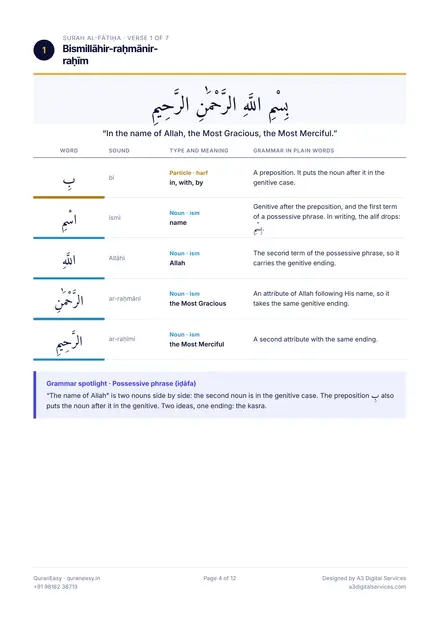
Ready to start? Book a free trial class or begin with the free Surah al-Fatiha guide.
1 comments