
Namaz Meaning Word by Word: Understand Every Phrase of Your Prayer
Live on Zoom with Sir Abdurrahim · Free trial class · Flexible schedules
- Format
- Live on Zoom
- Who
- Ages 15+, can read the Qur’an
- Languages
- Hindi · Urdu · English
- Tutor
- Sir Abdurrahim
- Start
- Free trial class
In short
- This page explains the main phrases of Namaz word by word: Arabic, sound, meaning and a grammar note.
- Surah al-Fatiha has its own free word-by-word PDF guide.
- Wording can differ slightly between schools of thought; the versions below are widely used in South Asia.
You say these words at least five times a day. When you understand them, your prayer gains khushūʿ: presence of heart. Here is what each phrase means and how its grammar works.
1. Takbīr: opening the prayer
اللَّهُ أَكْبَرُ
Allāhu akbar · “Allah is the Greatest.” اللَّهُ is the subject (mubtada’), so it ends in -u. أَكْبَرُ is on the pattern أَفْعَل, which makes comparatives and superlatives (“greater, greatest”). It is the predicate (khabar), also ending in -u. There is no “is” in Arabic: a noun followed by a noun is already a sentence.
2. Thanā’: praising Allah at the start
سُبْحَانَكَ اللَّهُمَّ وَبِحَمْدِكَ، وَتَبَارَكَ اسْمُكَ، وَتَعَالَىٰ جَدُّكَ، وَلَا إِلَٰهَ غَيْرُكَ
Subḥānaka Allāhumma wa bi-ḥamdik, wa tabāraka-smuk, wa taʿālā jadduk, wa lā ilāha ghayruk · “Glory be to You, O Allah, and with Your praise. Blessed is Your name, exalted is Your majesty, and there is no god besides You.” Notice the attached pronoun كَ (“You, Your”) repeated in almost every word: the whole phrase is addressed directly to Allah.
3. Taʿawwudh and Basmala
أَعُوذُ بِاللَّهِ مِنَ الشَّيْطَانِ الرَّجِيمِ
Aʿūdhu billāhi mina-sh-shayṭāni-r-rajīm · “I seek refuge with Allah from Satan, the accursed.” أَعُوذُ is a present-tense verb: the prefix أَ means “I”. بِ and مِنْ are prepositions, so the nouns after them end in -i.
بِسْمِ اللَّهِ الرَّحْمَٰنِ الرَّحِيمِ
Bismillāhi-r-raḥmāni-r-raḥīm · “In the name of Allah, the Most Gracious, the Most Merciful.” بِ (in) + اسْمِ (name) + اللَّهِ (of Allah) is a possessive phrase (iḍāfa). The two names that follow are adjectives that match اللَّهِ in its -i ending.
4. Surah al-Fatiha
Recited in every rakʿah. Each of its seven verses is explained word by word, with grammar spotlights, in the free Surah al-Fatiha guide.
5. Rukūʿ: bowing
سُبْحَانَ رَبِّيَ الْعَظِيمِ
Subḥāna rabbiya-l-ʿaẓīm · “Glory be to my Lord, the Most Great.” رَبِّيَ is رَبّ (Lord) + ي (my). الْعَظِيمِ is an adjective describing “my Lord”.
6. Rising from rukūʿ
سَمِعَ اللَّهُ لِمَنْ حَمِدَهُ · رَبَّنَا لَكَ الْحَمْدُ
Samiʿa-llāhu li-man ḥamidah · “Allah hears the one who praises Him.” سَمِعَ and حَمِدَ are past-tense verbs; the هُ at the end means “Him”. Rabbanā laka-l-ḥamd · “Our Lord, to You belongs all praise.” رَبَّنَا is رَبّ + نَا (our).
7. Sujūd: prostration
سُبْحَانَ رَبِّيَ الْأَعْلَىٰ
Subḥāna rabbiya-l-aʿlā · “Glory be to my Lord, the Most High.” الْأَعْلَىٰ is on the same pattern as أَكْبَر: the Most High.
8. Tashahhud (opening words)
التَّحِيَّاتُ لِلَّهِ وَالصَّلَوَاتُ وَالطَّيِّبَاتُ
At-taḥiyyātu lillāhi wa-ṣ-ṣalawātu wa-ṭ-ṭayyibāt · “All greetings, prayers and good things are for Allah.” The three nouns end in -āt, the sound feminine plural.
9. Taslīm: ending the prayer
السَّلَامُ عَلَيْكُمْ وَرَحْمَةُ اللَّهِ
As-salāmu ʿalaykum wa raḥmatu-llāh · “Peace be upon you, and the mercy of Allah.” رَحْمَةُ اللَّهِ is again a possessive phrase: “the mercy of Allah”.
Go further
These notes use only a handful of grammar ideas: subject and predicate, possessive phrases, prepositions and attached pronouns. Learn them properly in Quranic Arabic grammar basics, look up any term in the glossary, or see the full course syllabus.
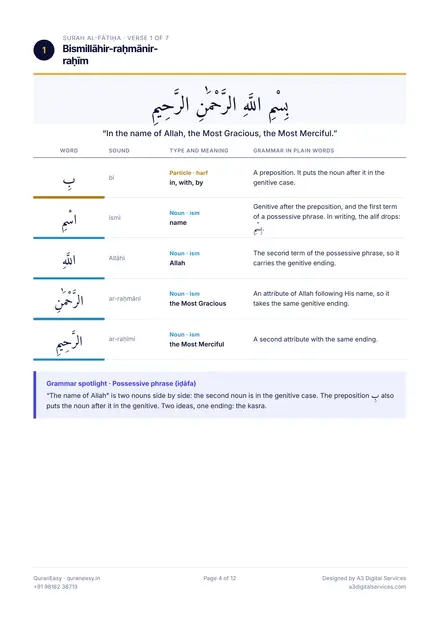
Free PDF download · 12 pages
Understand Surah al-Fatiha, word by word
The chapter you recite in every rak‘ah, taken apart. All seven verses, every word translated, colour-coded as noun, verb or particle, with the grammar explained in plain English. Each verse gets its own page.
- The complete Surah al-Fatiha, all 7 verses
- Word-by-word meaning, sound and grammar role
- A grammar spotlight for every verse
- A word bank of all 27 words to test yourself
Get the free guide
رَبِّ زِدْنِي عِلْمًا
Start with a free trial class
Tell us your level and the time that suits you. We will reply on WhatsApp or phone.