
Quranic Arabic Glossary: Grammar Terms Explained Simply
Live on Zoom with Sir Abdurrahim · Free trial class · Flexible schedules
- Format
- Live on Zoom
- Who
- Ages 15+, can read the Qur’an
- Languages
- Hindi · Urdu · English
- Tutor
- Sir Abdurrahim
- Start
- Free trial class
In short
- Short, plain-English definitions of the grammar terms used in Quranic Arabic classes.
- Each term has its Arabic name and, where possible, an example from Namaz or Surah al-Fatiha.
Use this glossary alongside Quranic Arabic grammar basics and Namaz meaning word by word. Each entry has its own link, so you can share a single term.
- اسْم Ism
- A noun: a word that names a person, thing, place, quality or idea, such as رَبّ (Lord) or الْحَمْد (the praise). Pronouns and adjectives also count as ism.
- فِعْل Fe’il (Fiʿl)
- A verb: a word that shows an action tied to time, such as نَعْبُدُ (we worship).
- حَرْف Harf
- A particle: a word that has meaning only together with other words, such as بِ (in, with) or لِ (for).
- إِعْرَاب Iʿrāb
- The change in a word’s ending that shows its role in the sentence. It is why the same word can end in -u, -a or -i.
- رَفْع Rafʿ (marfūʿ)
- The nominative case, usually marked by a ḍamma (-u). The subject of a sentence is marfūʿ: الْحَمْدُ.
- نَصْب Naṣb (manṣūb)
- The accusative case, usually marked by a fatḥa (-a). The object of a verb is manṣūb: إِيَّاكَ نَعْبُدُ.
- جَرّ Jarr (majrūr)
- The genitive case, usually marked by a kasra (-i). A noun after a preposition is majrūr: بِسْمِ اللَّهِ.
- ضَمَّة Ḍamma
- The short vowel “u” written as a small wāw above the letter.
- فَتْحَة Fatḥa
- The short vowel “a” written as a small stroke above the letter.
- كَسْرَة Kasra
- The short vowel “i” written as a small stroke below the letter.
- سُكُون Sukūn
- A small circle above a letter showing it has no vowel.
- تَنْوِين Tanwīn
- A doubled vowel mark that adds an “n” sound (-un, -an, -in). It usually marks a noun as indefinite: هُدًى (a guidance).
- الْ Al- (definite article)
- The prefix meaning “the”. A noun with al- never takes tanwīn: الْكِتَابُ (the Book).
- مُبْتَدَأ Mubtada’
- The subject of a nominal sentence (a sentence that begins with a noun). In الْحَمْدُ لِلَّهِ the mubtada’ is الْحَمْدُ.
- خَبَر Khabar
- The predicate of a nominal sentence: what is said about the mubtada’. In اللَّهُ أَكْبَرُ the khabar is أَكْبَرُ.
- فَاعِل Fāʿil
- The doer of a verb’s action. In نَعْبُدُ the doer is “we”, contained in the verb.
- مَفْعُول بِهِ Mafʿūl bihi
- The direct object: the one the action falls on. It is manṣūb.
- إِضَافَة Iḍāfa
- The possessive construction “X of Y”, such as رَبِّ الْعَالَمِينَ (Lord of the worlds). The second noun is always majrūr.
- مُضَاف / مُضَاف إِلَيْه Muḍāf / Muḍāf ilayh
- The first and second terms of an iḍāfa. In اسْمِ اللَّهِ, اسْمِ is the muḍāf and اللَّهِ is the muḍāf ilayh.
- حَرْف جَرّ Ḥarf jarr
- A preposition such as بِ، لِ، مِنْ، فِي، عَلَىٰ. The noun after it is majrūr.
- ضَمِير Ḍamīr
- A pronoun. It can be detached (أَنْتَ, إِيَّاكَ) or attached to a word (رَبُّنَا, “our Lord”).
- صِفَة Ṣifa (naʿt)
- An adjective. It follows its noun and matches it in case and definiteness: الرَّحْمَٰنِ الرَّحِيمِ.
- مَاضٍ Māḍī
- The past-tense verb, such as أَنْعَمْتَ (You have favoured).
- مُضَارِع Muḍāriʿ
- The present/future-tense verb, marked by a prefix: نَعْبُدُ (we worship), نَسْتَعِينُ (we ask for help).
- أَمْر Amr
- The command (imperative) verb, such as اهْدِنَا (guide us) and اقْرَأْ (read).
- جِذْر Jidhr (root)
- The usually three-letter core that carries a word’s basic meaning. ح م د gives حَمْد (praise), مَحْمُود (praised) and مُحَمَّد.
- وَزْن Wazn (pattern)
- The template a root is poured into. The pattern أَفْعَل gives أَكْبَر (greater) and أَعْلَىٰ (higher).
- مُفْرَد، مُثَنًّى، جَمْع Mufrad, Muthannā, Jamʿ
- Singular, dual (exactly two) and plural. Arabic has a separate form for two.
- مُذَكَّر / مُؤَنَّث Mudhakkar / Mu’annath
- Masculine and feminine. Many feminine nouns end in tā’ marbūṭa (ة), such as رَحْمَة (mercy).
- خُشُوع Khushūʿ
- Humility and presence of heart in prayer. Understanding what you recite helps build it.
- تَجْوِيد Tajwīd
- The rules for reciting the Qur’an correctly. It is about sound; grammar is about meaning.
- تَفْسِير Tafsīr
- Explanation and commentary of the Qur’an by scholars. Grammar helps you follow a tafsīr more closely.
Want to learn these properly, live? See the course syllabus or book a free trial class.
Free PDF download · 12 pages
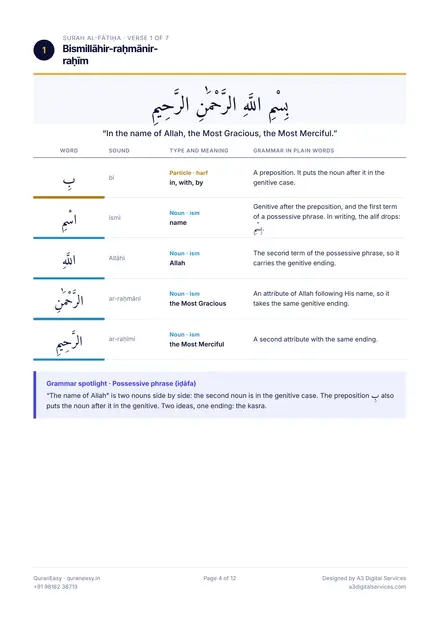
Understand Surah al-Fatiha, word by word
The chapter you recite in every rak‘ah, taken apart. All seven verses, every word translated, colour-coded as noun, verb or particle, with the grammar explained in plain English. Each verse gets its own page.
- The complete Surah al-Fatiha, all 7 verses
- Word-by-word meaning, sound and grammar role
- A grammar spotlight for every verse
- A word bank of all 27 words to test yourself
Get the free guide
رَبِّ زِدْنِي عِلْمًا
Start with a free trial class
Tell us your level and the time that suits you. We will reply on WhatsApp or phone.