How a Working Professional Can Learn to Understand the Qur’an
· Updated · 5 min read · by QuranEasy team
In short
- You do not need hours a day: 15–20 minutes daily plus a live class is enough to make real progress.
- Attach study to things you already do: after Fajr, on the commute, before Isha.
- Learn grammar, not endless word lists: a few ideas unlock a large part of the Qur’an.
- A fixed live class gives accountability, which is what most busy adults lack.
You manage meetings, deadlines, travel and family, and you pray five times a day. Many professionals recite the Qur’an faithfully and still feel a gap: they do not understand what they are saying. Adding serious study can feel impossible. It is not, if the plan fits real life. This article is a practical guide written for doctors, engineers, IT professionals, teachers, business owners and anyone with a full calendar.
Why professionals struggle (and why it is not about intelligence)
- Unstructured self-study. Apps and videos are easy to start and easy to abandon. Without a path, progress stalls.
- The wrong course. Spoken-Arabic courses spend months on conversation you will not use. See Quranic Arabic vs Modern Standard Arabic.
- All-or-nothing planning. Waiting for a free weekend means waiting forever.
- No one to ask. A small confusion becomes a reason to stop.
Professionals are usually very good at learning when the goal and the system are clear. The aim is to give your study the same structure you give your work.
How much time does it really take?
A realistic routine for most working adults:
- Daily: 15–20 minutes of review and one new phrase or verse.
- Weekly: your live class, plus 30 minutes to go over the lesson.
Over six months, that adds up to a solid foundation. Our Quranic Arabic Course is built around exactly this timescale: six months, live on Zoom, with flexible batch timings.
Where to fit study into a working day
After Fajr
The quietest time of the day for most people. Ten minutes on one phrase before the phone takes over.
The commute
If you are not driving, review your notes or listen to the phrase you are learning. If you are driving, recite the phrase you learned this morning and recall its meaning.
Lunch or a short break
Five minutes to test yourself on the week’s words.
Before Isha or before sleep
Quick review, so the new phrase is fresh for tomorrow’s prayers.
Linking a new habit to an existing one (a prayer, a commute, a meal) is what makes it stick. Pick two anchors, not five.
What to learn first
- The phrases of your Namaz. You use them five times a day, so they reinforce themselves (Namaz meaning word by word).
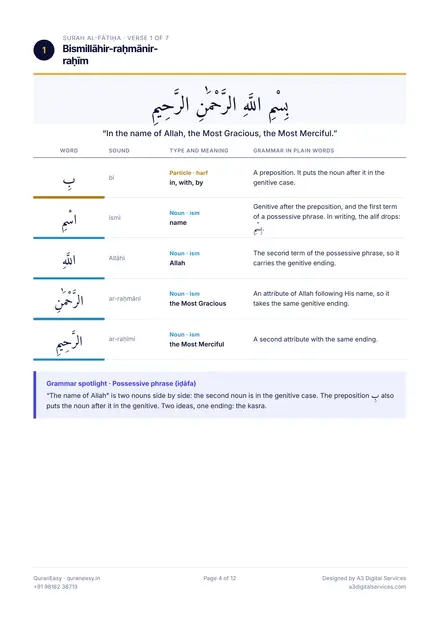
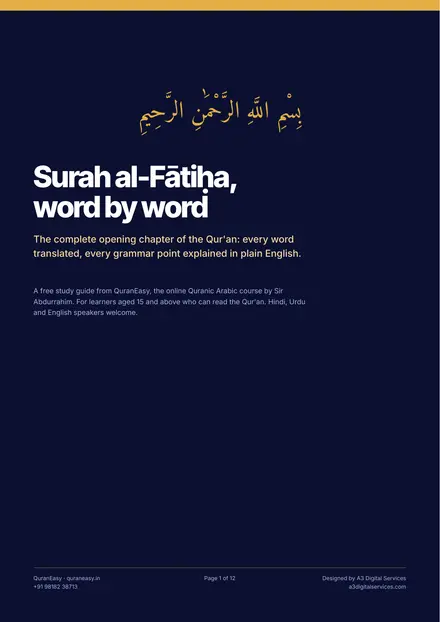
- Surah al-Fatiha, word by word. Seven verses you recite in every rakʿah (free PDF guide).
- The core grammar. Three kinds of words, case endings, possessive phrases and pronouns (grammar basics).
- The root system. Once you see that one root builds a family of words, vocabulary grows much faster.
Grammar first, vocabulary second. A word list never ends; a handful of grammar ideas lets you decode words you have never studied.
Staying consistent for six months
- Put the live class in your calendar like a meeting. Protect it the same way.
- Keep a single notebook. One phrase per page: Arabic, meaning, grammar note.
- Use the prayer as your test. In each Salah, notice one phrase you now understand.
- Plan for busy weeks. On a heavy week, do five minutes instead of twenty. Do not skip completely.
- Tell your teacher when you are stuck. That is what the live class is for.
Learning while travelling or working abroad
Online classes mean your location does not matter. Learners join from Delhi NCR, Mumbai, Bengaluru, Hyderabad and across India, and from Dubai, Riyadh, Doha, London, Toronto and beyond. Tell us your country and working hours when you enquire and we will suggest the batch timing that suits you. More on our page for working professionals.
What you gain
- Understanding what you say in Namaz, with more presence (khushūʿ)
- A direct connection with the Qur’an, not only through translation
- Confidence when reading translations and tafsīr, because you can see the grammar behind them
- A learning habit you can continue for life
Frequently asked questions
I work long hours. Is a 6-month course realistic?
Yes, if you plan for 15–20 minutes a day and protect your weekly class. The course is designed for working adults, with flexible batch timings.
What if I miss a class because of work?
Let your teacher know. Catching up early is much easier than falling behind for weeks.
Do I need any Arabic before starting?
No. You only need to be able to read the Qur’an. You must be 15 or older.
Which language are the classes in?
Hindi, Urdu or English (details).
Start today with the free Surah al-Fatiha guide, then book a free trial class and tell us your working hours.